Bioinformaticianman begins!
This post introduces the character Bioinformaticianman: an everyday hero fighting cancer in his own way using bioinformatics.
TL;DR: Bioinformaticianman is an everyday hero. This post is the first in a series introducing the character and his endeavor to fight cancer…
Intro
I often find it hard to explain exactly what my research is about. According to the following quote, often attributed to Albert Einstein, I have failed to understand well enough what I am doing.
If you can’t explain it simply, you don’t understand it well enough.
I do not disagree with this. I am working in an interdisciplinary branch of science, which requires a good knowledge and command of biology (more specificially molecular biology, in my case), mathematics (more specifically statistics), and computer science (more specifically programming and working with large, untidy, noisy data). My job requires using computer scripts and bioinformatics tools to tidy up the data, clean it as much as possible from garbage such as noise and biases, summarize it, and make inferences from it using statistical methods. Finally, I need to interpret the results and put it into perspective in the context of biology, what is known and what remains unknown. I find it challenging to condense this complexity into a couple of sentences and still expect that the audience genuinely grasps what I am actually doing. That’s why, I have been satisficing by saying, “I am a bioinformatician.” I believe this could be remedied to some extent by using a medium that complements the text, for example using images. However, generating engaging and expressive images takes time and requires experience, for example, in drawing. This, however, is about to change.
Artificial intelligence (AI) to the rescue
Recent advances in AI, such as the introduction of the Large Language Model (LLM) and text-to-image generative AI models are providing opportunities to overcome some of such challenges, such as the one I described above. For example, the latest text-to-image model by OpenAI, the 4o Image Generation is quite impressive, as it allows for generating engaging images combined with text to convey complex ideas and procedures in a manner that is not overwhelming. The 4o Image Generation model allows one to upload a crummy sketch, and a prompt, and after a couple of back-and-forth iterations, one ends up with an impressive result such as the following image.
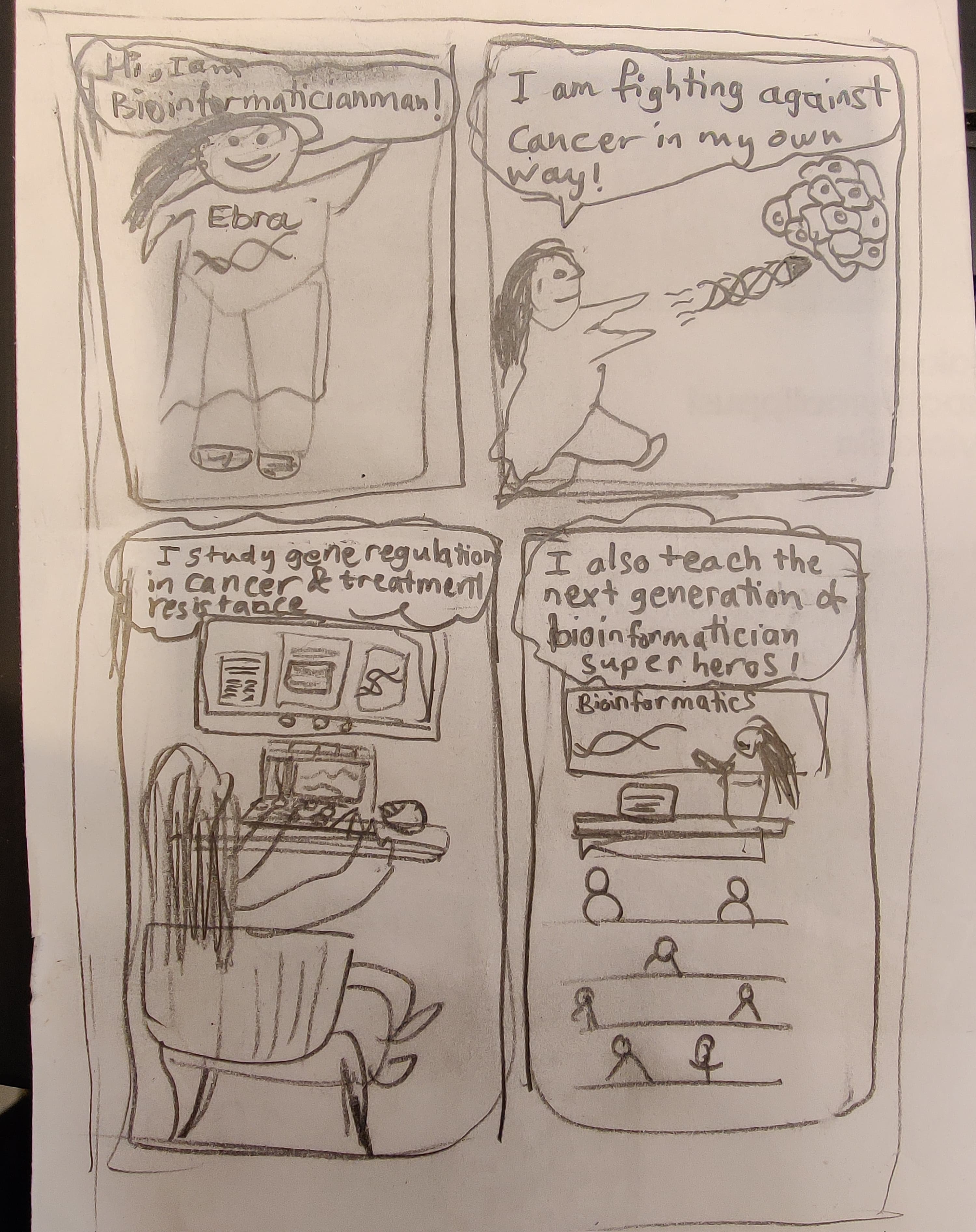
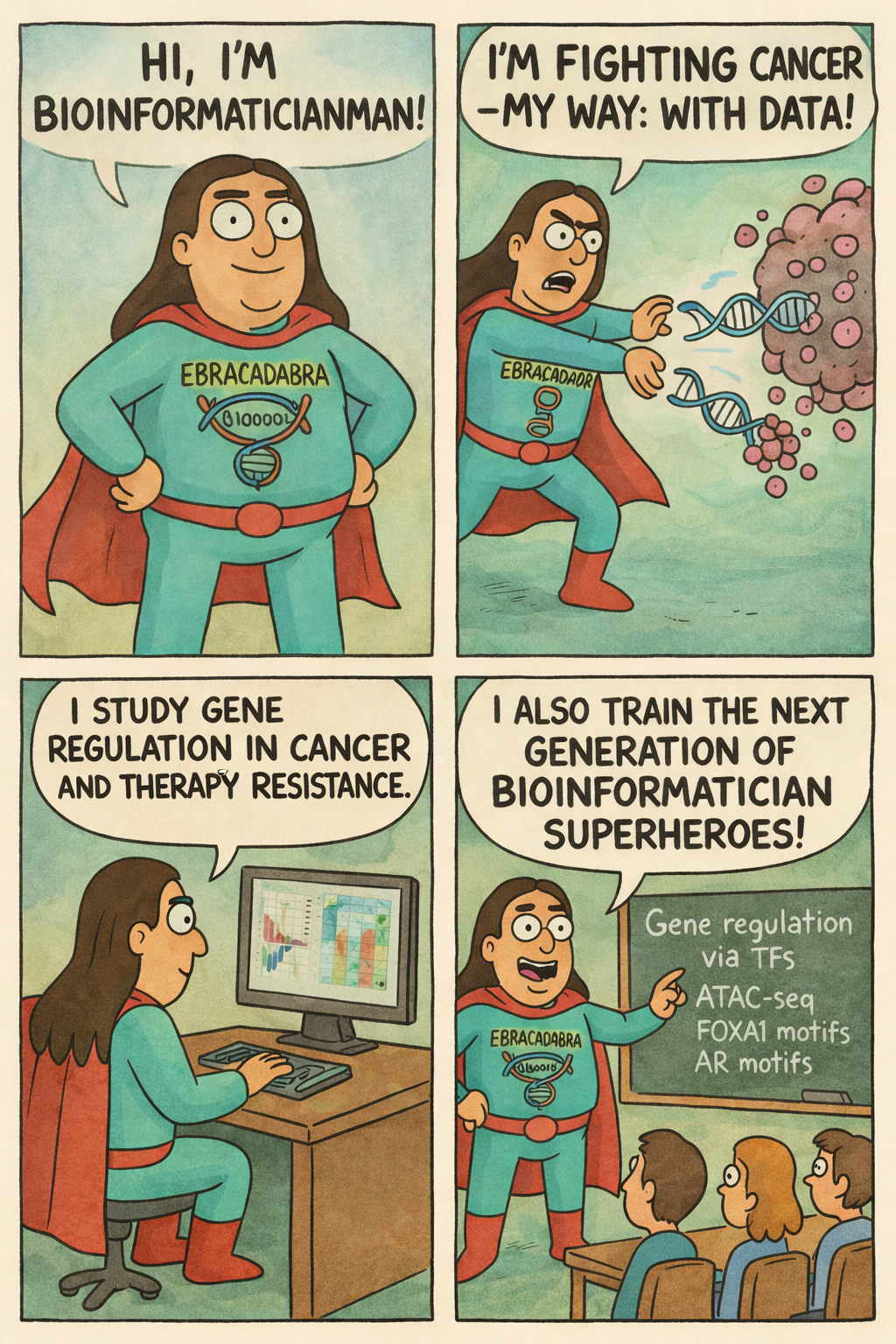
Bioinformaticianman begins!
Seeing this as an opportunity for science outreach (and as a way to finally escape my predicament of not being able to explain what I do in a simple manner), I have created the character of “Bioinformaticianman”, an everyday hero who uses bioinformatics to fight cancer. In a series of upcoming posts, I intend to introduce this character and his endeavor fight cancer. Let it begin! 
Note: I chose “Bioinformaticianman” instead of “Bioinformatician-man” because it sounds more like someone who fights genome crimes committed by cancer cells.